
Long-Form Article vs. Carousel Post on WeChat Official Account: Where Should Brands Place Their Bets?
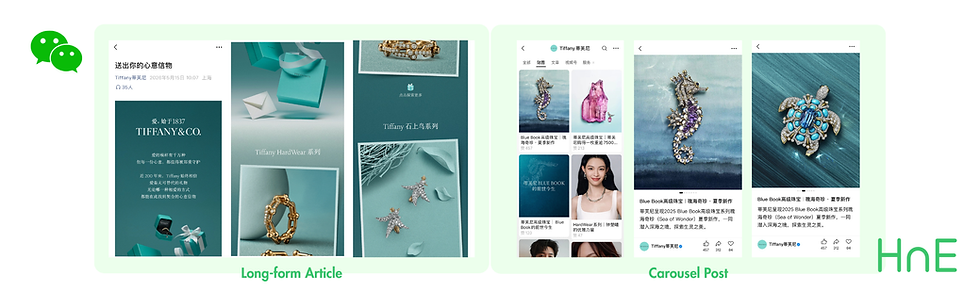
As of 2025, the monthly active accounts of WeChat (also called Weixin) had reached 1.41 billion, while the WeChat official account platform alone attracted 780 million daily active users. For brands seeking to build long-term consumer relationships in China, this remains one of the most important private-traffic channels. The platform generates 120 million content shares every day, and users open WeChat an average of 38 times per day.
However, the rules of the platform have changed dramatically. In 2025, WeChat fully rolled out algorithmic recommendation, fundamentally reshaping how content is distributed. Today, more than 50% of the traffic for an average article comes from recommendations rather than follower subscriptions alone; for smaller accounts, this figure can rise to as high as 70%. This shift means brands must rethink not only what they publish, but also how they publish.
Should we choose Long-Form Article or images for WeChat official account marketing?
1. The Core Marketing Differences Between Long-Form Article and Carousel Post

For years, the WeChat official account platform was almost synonymous with in-depth Long-Form Article. A typical post usually ranges from 1,000 to over 3,000 words and requires substantial editorial investment, including research, structure, multiple rounds of revision, and refined visual design. This makes long-form content a powerful tool for media organizations and established large accounts, but it also creates a structural barrier for ordinary creators and small to mid-sized brands. As some industry observers have pointed out, many users feel that truly valuable information can often be conveyed in just a few sentences, yet the platform’s long-form inertia pushes creators to expand and elaborate, which can sometimes work against both readers and writers.
Carousel post, by contrast, are a format that WeChat has actively supported in recent years. Notably, this image-led creative style is one of the primary content models pioneered by Xiaohongshu (Rednote). Following the significant market success of Xiaohongshu’s format, WeChat likely sought to emulate this approach to capture a similar user demographic.

This lightweight, image-first format is WeChat’s response to both that structural imbalance and the competitive pressure to offer Xiaohongshu-style content experiences. While this format first emerged around 2025, it was in 2026 that the WeChat team began to push this feature aggressively, even undergoing a major interface redesign to prioritize this specific function. It allows creators to publish directly from mobile devices at very low cost. Positioned between deep long-form content and short video, it fits today’s fragmented reading habits and the growing demand for lighter, faster content consumption.
The platform has signaled its support through concrete product changes. The image-post entry point has been moved ahead of article listings on WeChat official account homepages, and the format now receives preferential algorithmic exposure in surfaces such as “Top Stories,” discovery feeds, and WeChat Search. For new accounts, this means they can gain exposure without relying on an existing follower base. On a platform once dominated by subscription-based distribution, this represents a major redistribution of traffic.

The strategic differences between the two formats can be summarized as follows:
Comparison Dimension | Carousel Post | Traditional Long-Form Article |
Presentation Format | Image-led, supported by short text. Users can consume the content directly in the feed without clicking into a separate page. | Text-led and requires users to click into the full article page, allowing for deeper storytelling and richer narrative development. |
Traffic Logic | Strong traffic support across multiple discovery scenarios. Carousel Post currently receive prominent exposure in Service Account feeds, WeChat official account homepage, recommendation feeds, and WeChat search. Even accounts with zero followers can create breakout content. | Driven more by subscription base and long-tail search traffic. Although algorithmic recommendation now plays a larger role, overall readership still depends heavily on follower base and social sharing. |
Content Production Threshold | Very low. A few authentic photos with a short caption are enough to publish, making this format highly compatible with fragmented reading habits. | Relatively high. It requires stronger content depth, clearer logic, and more systematic editorial development, resulting in a longer production cycle. |
2. Strategic Adjustments Brands Need in the New WeChat Content Environment
2.1. Embrace a Dual-Engine Model: Subscription + Recommendation
The era when large follower counts automatically meant broad exposure is over. Today, WeChat traffic is driven by three parallel mechanisms: follower base, social sharing, and algorithmic recommendation. Brands must optimize for all three.
To win in recommendation-based distribution, content must maximize reading duration and engagement rate, two of the most important factors in recommendation weighting. That means the first 100 words of an article need a strong hook, paragraphs must be easy to scan, and visual rhythm must sustain attention.
To encourage social sharing, content must tap into either emotional resonance or practical value, the two strongest drivers of reposting in Chinese social culture.
To improve search visibility, brands must also think seriously about keyword placement within WeChat’s internal search engine. This is where WeChat SEO/ GEO becomes increasingly important. Strategic keyword integration in headlines and body copy can significantly improve discoverability through search.
2.2. Build a Layered Content Matrix
The smartest brands are now planning their content calendars in a three-layer structure.
The first layer is authority-building content, mainly in the form of deep long-form article. These include industry trend analysis, original research reports, comprehensive guides, and brand storytelling. This type of content supports WeChat SEO/ GEO objectives and builds long-term credibility. It also serves as foundational content that can later be repurposed into lighter formats.
The second layer is daily engagement content, primarily carousel post. These can be published daily or at high frequency, keeping the brand visible without exhausting editorial resources. The low production barrier of carousel post ensures a constant presence, while algorithmic preference for this format helps attract new readers.
The third layer is conversion-oriented content flow, where long-form content, carousel post teasers, and WeChat channels videos all point toward a unified conversion goal, such as purchases through WeChat mini-program, lead collection, or adding a customer service WeCom account.
2.3. Plan Your Content Across the WeChat Ecosystem
A modern brand presence on WeChat spans at least five interconnected touchpoints: WeChat official account, including both long-form article and carousel post; WeChat channels; WeCom; WeChat mini-program; and private community WeChat groups. Success depends on an integrated WeChat ecosystem strategy in which each touchpoint has a distinct role but all serve the same commercial objective.
This means WeChat official account marketing should not be treated as a standalone publishing function. Instead, it should act as the narrative and traffic hub within the broader WeChat ecosystem, connecting content exposure with relationship management and conversion infrastructure.
3. Case Studies
International Brand Case: Tiffany & Co. — Reinventing Long-Form Reading Through Interactive Design
Tiffany & Co.’s WeChat strategy demonstrates how an international luxury brand can win in the long-form category by upgrading the reading experience through visual and interactive technology.
Instead of diluting brand equity through high-frequency, low-cost carousel post, Tiffany invested heavily in interactive SVG-based long-form storytelling, transforming traditional articles into immersive digital experiences. Its approach includes parallax scrolling, tap-to-expand narrative structures, and pop-up card interactions, all executed within the refined visual language expected of a luxury brand.
The key takeaway is Tiffany’s refusal to compromise on quality over quantity. Its interactive articles often use staged narrative progression. For example, in one story about trophy craftsmanship, the visuals gradually shift from black and white to color as users scroll downward, creating a cinematic journey through the making process. This strategy delivers several benefits.
First, it protects premium brand positioning by avoiding the fatigue associated with excessive posting. Second, it leverages WeChat’s unique technical capabilities to create a differentiated experience that other platforms cannot easily replicate. Third, it drives organic sharing through a sense of visual surprise and delight. Fourth, it preserves long-term search visibility, because keyword-rich long-form content remains a searchable asset over time, strengthening WeChat SEO/ GEO performance.
As industry analysis has shown, among six luxury brands studied in 2025 — Hermès, Chanel, Louis Vuitton, Prada, Fendi, and Burberry — 100% of published content used either purely visual or SVG-based interactive formats. Hermès even converted all of its content into SVG form. Notably, although Louis Vuitton published the fewest articles, it achieved the highest proportion of 100,000+ view articles at 47.06%, proving once again that strategic depth matters more than publishing volume.
Domestic Brand Case: Yunnan Baiyao — Ecosystem Coordination and Tactical Agility
Yunnan Baiyao, a century-old Chinese healthcare and wellness brand, offers a very different yet equally instructive model. Its success is not built on dependence on one single format, but on coordination across the WeChat ecosystem.
At the beginning of 2025, Yunnan Baiyao seized the opportunity created by WeChat’s newly introduced gifting function. Its cross-touchpoint campaign shows how a domestic brand can mobilize platform traffic characteristics with precision.
On the WeChat official account, the brand published in-depth Long-Form Article focused on gift-giving scenarios and health product selection guidance. These articles were built around holiday gifting pain points and performed strongly in search, reinforcing WeChat SEO/ GEO value.
On WeChat channels, the brand used store-visit content and short product demonstrations to build visual trust and emotional connection.
Its mini-program mall then seamlessly converted traffic generated by all content paths into purchases.
Meanwhile, WeChat moments ads were deployed with location-based targeting across Southwest China, including Yunnan, Guizhou, Sichuan, and Chongqing, balancing cost-efficiency with relevance.
At the same time, the brand also leveraged WeChat search brand-zone placement to capture high-intent search traffic.
The campaign results were significant: total exposure exceeded 50 million, while engagement surpassed 500,000 interactions. More importantly, the brand established a durable mental association in the public mind: “For gifts of health, choose Yunnan Baiyao.” This outcome reflects not only strong tactical execution, but also a well-positioned strategy built on a holistic view of the WeChat ecosystem.
4. Conclusion: A Strategic Framework for the New WeChat Era
WeChat has evolved from a platform dominated by subscription-based long-form publishing into a hybrid ecosystem where depth and lightweight content coexist. This transformation presents both challenges and opportunities.
For international brands that are accustomed to polished, campaign-style communication, the shift toward always-on, algorithm-driven distribution requires the development of new operating capabilities. For domestic brands, the challenge lies in maintaining strategic discipline in an increasingly fragmented content environment.
The way forward rests on three pillars.
The first is format flexibility. Brands should deploy Long-Form Article to build authority and search barriers, use Carousel Post to capture algorithmic traffic and support daily engagement, and leverage WeChat channels to create emotional connection. No single format can support a brand’s WeChat presence on its own.
The second is ecosystem integration. Brands should treat the WeChat official account as a hub rather than an isolated channel, connecting it to WeCom, mini-programs, and private community operations. The goal is not only reach, but relationship depth. This is the essence of a mature WeChat content strategy.
The third is algorithm literacy. Brands must understand that traffic now comes from three independent sources — subscription, social sharing, and recommendation — each requiring different optimization approaches. Metrics such as reading duration and engagement rate are now as important as total follower count in WeChat official account marketing.
As WeChat continues to refine its content environment, one principle remains unchanged: the platform rewards brands that create genuine value for their audiences. Whether through a highly polished interactive article or a visually refined image post, the brands that will continue to lead are those that can adapt to new formats while staying anchored in authentic connection with their communities.
References:


Comments